Basic Dog Commands: A Simple Plan That Sticks
By:Author:Raising Dog Editorial
Updated on:October 20, 2026
- Do Basic Dog Commands Actually Work?
- One Command at a Time or All Five Together
- Why One Command at a Time Beats Teaching Them All at Once
- Adapting Basic Commands to Your Dog and Your Week
- Making Command Practice Fit an Ordinary Week
- The Myth of the One-Day Obedient Dog
- Teaching Basic Dog Commands With Raising Dog's Lesson Plans
- Starting Command Training This Week
Basic dog commands - sit, stay, come, down and leave it - stick fastest when you teach one at a time, in short sessions, with the same word and hand signal every time.
Dogs do not learn English. They learn patterns: a cue, an action, a consequence, repeated enough times that the pattern becomes automatic.
This article covers whether basic commands actually work, how much practice they take, how to fit training into a real week, and what to do when progress feels slow.
Do Basic Dog Commands Actually Work?
Yes, in the sense that almost any dog can learn to respond to a cue reliably, because learning by association is how dogs process the world anyway.
The mechanism is simple. You pair a word with an action the dog is already doing or can be guided into, then reward it, and repetition builds the link.
The Arithmetic of Repetition
If you practise one command for two minutes, twice a day, that is four minutes daily, or roughly 28 minutes a week.
Over four weeks that adds up to close to two hours of focused repetition on a single skill, which is enough for most dogs to show a noticeable change in how quickly they respond.
What it does not guarantee is a fixed date when the command becomes perfect, because every dog's pace is different and distractions reset progress temporarily.
One Command at a Time or All Five Together
Most people weigh two approaches: teach one command until it is solid, then move to the next, or introduce several commands in the same week.
Here is how the two compare across the things that actually matter day to day.
| Factor | One Command First | All Together |
|---|---|---|
| Speed to first success | Fast, within days | Slower, more confusion |
| Risk of mixed-up cues | Low | Higher early on |
| Session length needed | Short, 2-3 minutes | Longer, 8-10 minutes |
| Best for busy weeks | Yes | Harder to fit in |
| Good for food-driven dogs | Yes | Yes, with patience |
Neither approach is wrong, but one command at a time tends to fit more easily into an ordinary day and produces a clear win sooner.
Why One Command at a Time Beats Teaching Them All at Once
Teaching five commands in one week sounds efficient, but it asks a dog to sort through more new information than it can hold onto.
One command at a time is unglamorous. It is slower on paper, but it is the version people actually stick with, because a two-minute session feels doable even on a tired evening.
Consistency beats intensity here. A dog that gets short, repeated practice on 'sit' five days a week will usually out-pace a dog drilled for twenty minutes once and then left alone for a week.
The harder alternative - cramming several commands into long sessions - also raises the odds of a frustrated dog or a frustrated handler, and frustration is what makes people quit training altogether.
Adapting Basic Commands to Your Dog and Your Week
New Puppies
Young puppies have short attention spans, so sessions under two minutes work better than long drills, and food rewards usually hold their focus best.
Older Dogs Learning Late
An older dog can still learn basic commands, it just may need more repetitions to override existing habits, so patience matters more than speed.
Busy Households
If the week is packed, two or three one-minute sessions spread across the day beat trying to find one long uninterrupted block.
Easily Distracted Dogs
Dogs that struggle to focus around noise or other pets often do better starting in a quiet room before practising the same command somewhere busier.
Making Command Practice Fit an Ordinary Week
Training does not need its own slot on the calendar to work. Commands fit naturally into moments that already happen - before meals, before a walk, before the door opens.
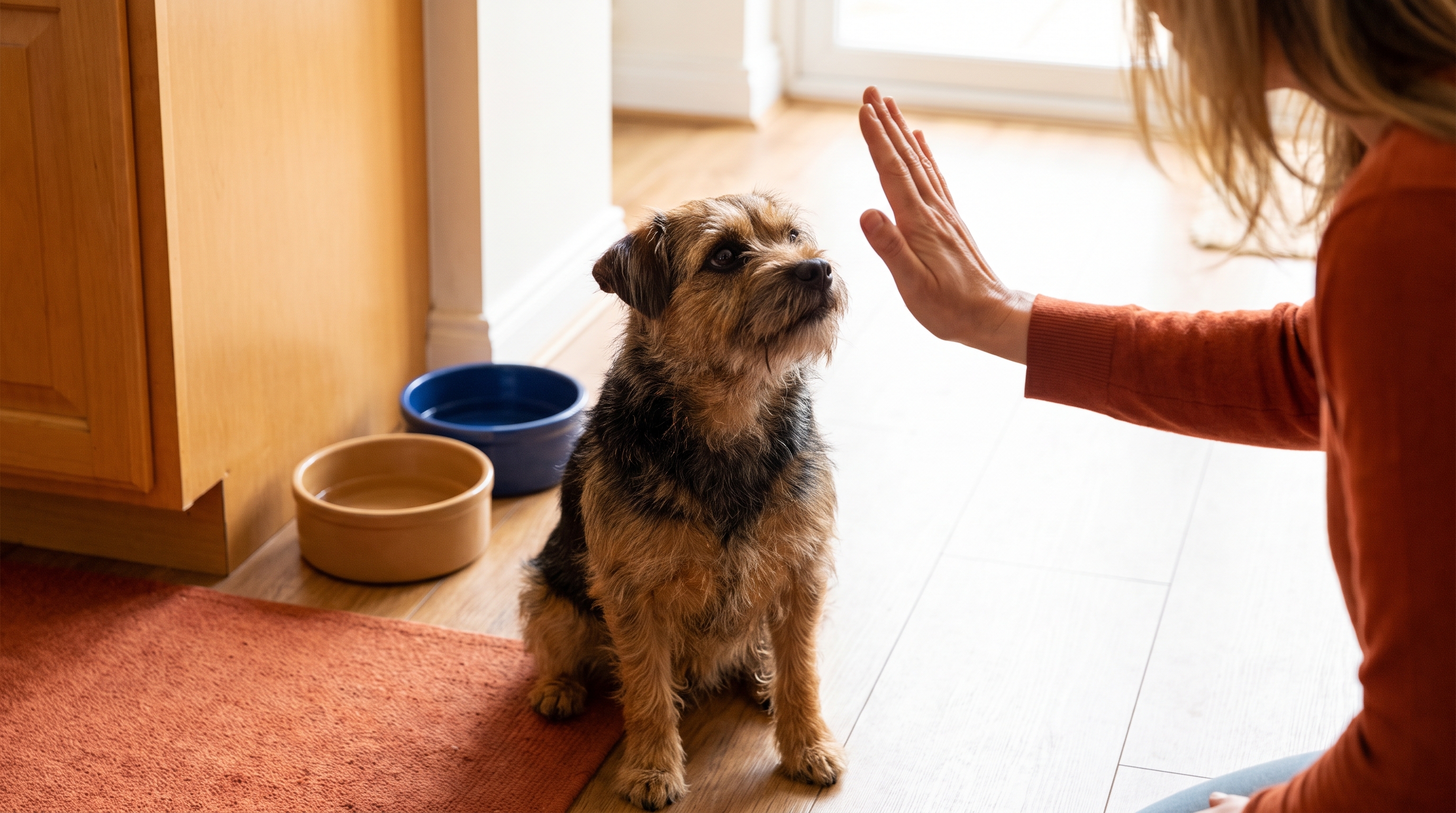
Asking for a sit before putting the food bowl down, or a stay before opening the front door, turns a routine moment into free practice without adding time to the day.
This is where having a clear, step-by-step plan for your dog's age and stage makes the difference between guessing and progressing - which is the gap Raising Dog's lesson structure is built to close.
Rather than a generic list of commands, the lessons adjust to where your dog actually is, so the next session always makes sense given the last one.
The Myth of the One-Day Obedient Dog
No dog becomes fully obedient in a single session, no matter how good the trainer or how smart the dog.
Commands that look solid in a quiet living room often fall apart the first time there is a squirrel, a doorbell or another dog nearby, and that is normal, not a failure.
The honest answer is that reliability builds in layers: first the command works at home, then with mild distraction, then out in the world, and each layer takes its own stretch of repeated practice.
There is no shortcut that skips the layers, but there is also no reason to expect perfection by any particular date.
Teaching Basic Dog Commands With Raising Dog's Lesson Plans
Generic command lists tell you what to teach but not how to adjust when your dog is struggling, bored, or ready to move faster than expected.
Raising Dog is built around lessons tailored to your dog's age and unique needs, so the sequence of commands matches where your dog actually is rather than a one-size-fits-all script.
Alongside the core skills, it includes tips to overcome behaviour issues, tricks and games for bonding, and health and nutrition guidance, so command training sits inside a fuller picture of raising your dog rather than standing alone.
The companion app tracks your dog's progress and offers actionable insights, so you always know which command to focus on next and can keep the digital guide with you wherever practice happens.
Raise A Happy Dog
Train Your Dog Right
Starting Command Training This Week
Pick one command, practise it in short bursts around moments that already happen in the day, and let the next command wait until the first one feels automatic.
If you want a sequence that adjusts as your dog improves rather than a static checklist, Raising Dog's lesson plans are built to do exactly that, one session at a time.
FAQ
Most households get the most practical value from sit, stay, come, down and leave it, since these cover everyday safety and manners. There is no need to rush beyond these before they are solid.
This is a normal early stage, not a sign of failure, because food is simply the clearest way to mark the right behaviour at first. Rewards can be phased out gradually once the command is consistent in low-distraction settings.
Usually it is inconsistency, not difficulty, since skipping days or changing the cue word slows the pattern the dog is trying to learn. Raising Dog's tracking tools help keep sessions regular by showing exactly what was practised and when.
Distraction resets reliability, so a command that works perfectly indoors can look brand new on a busy street. That is expected, and it just means practising the same command in gradually busier places rather than assuming the dog has forgotten it.
Share this post