Leash Training A Puppy: A Calm Path To Walking Nicely
By:Author:Raising Dog Editorial
Updated on:October 20, 2026
- Does Leash Training a Puppy Actually Work?
- Stop-And-Go Method or Front-Clip Harness: The Choice
- Why Stopping and Waiting Beats Yanking the Leash
- Adapting Leash Walks to Different Puppies and Routines
- Fitting Leash Practice Into an Ordinary Week
- Can a Puppy Learn Loose-Leash Walking Overnight?
- Making Raising Dog Part of Leash Training a Puppy
- Starting Tonight's Walk Differently
Leash training a puppy means teaching them that a loose leash gets them where they want to go, while pulling stops the walk. It works through repetition, not correction - the puppy learns the pattern because it happens the same way every single time.
The mechanism is simple: puppies repeat whatever gets rewarded. If pulling moves them forward, they pull. If pulling makes the walk stop and a loose leash starts it again, they stop pulling.
This article covers whether leash training actually works, how much of it a puppy needs, the choice between training it yourself and leaning on equipment, and how to adapt the plan around a real schedule.
Does Leash Training a Puppy Actually Work?
Yes, in the sense that puppies do learn patterns that get repeated consistently - that is how all dog learning works, not something specific to leashes.
A puppy that pulls has, somewhere along the way, learned that pulling gets results. Pulling drags the walker forward, the walker keeps moving, and the puppy reaches the smell or the dog or the gate a few seconds sooner.
The Arithmetic of a Short Walk
Picture a 15-minute walk made of thirty or forty short exchanges between puppy and handler - a tug, a stop, a loose leash, a few steps forward. Each one is a tiny lesson, and over a week that is hundreds of repetitions, which is where the learning actually accumulates, not in any single walk.
That is the honest version: no single walk fixes pulling, but the pattern repeated across many walks changes what the puppy expects from the leash.
Stop-And-Go Method or Front-Clip Harness: The Choice
Most people deciding how to leash train a puppy are really choosing between two routes: teaching the behaviour directly through stop-and-go walking, or managing the pulling with equipment like a front-clip harness while the behaviour catches up.
Neither is wrong, and plenty of households use both at once - here is how they compare on the things that matter day to day.
| Factor | Stop-And-Go Training | Front-Clip Harness |
|---|---|---|
| What it teaches | Loose leash earns movement | Reduces pulling strength |
| Setup time | None needed | Fitting required |
| Effort per walk | Higher, early on | Lower, ongoing |
| Works without equipment | Yes | No |
| Addresses the habit | Directly | Indirectly |
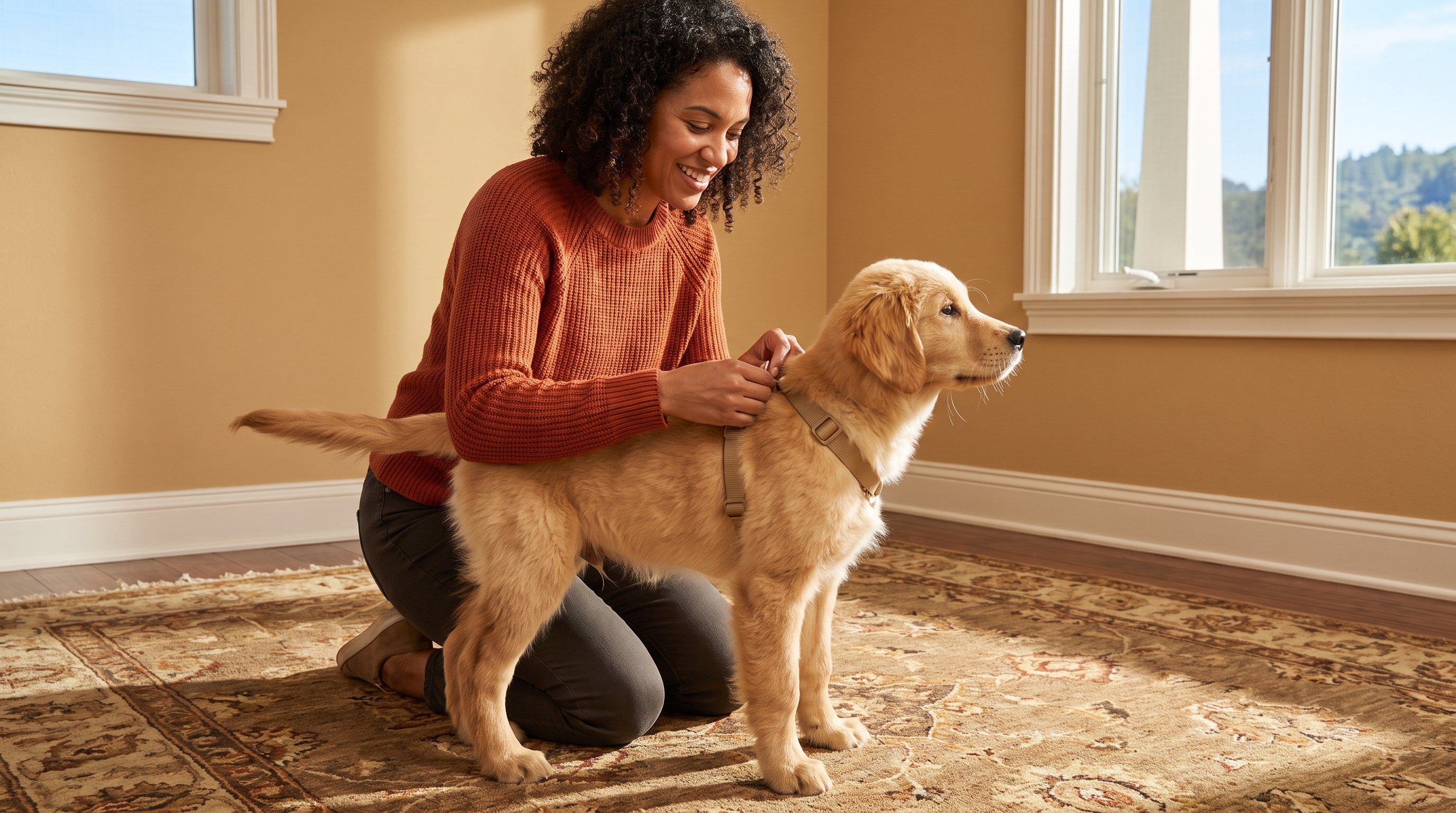
A harness can take the strain off a person's arm while the puppy is still learning, but it does not teach the puppy anything about why pulling does not pay off.
Why Stopping and Waiting Beats Yanking the Leash
The harder alternative here is correcting the pull - a tug back, a sharp word, repeated every time the puppy surges forward. It can suppress pulling in the moment, but it has to be repeated forever because the puppy never actually learns the rule.
Stopping and waiting for slack is slower to see change and far easier to keep doing, because it asks nothing physical of the handler beyond patience.
A method that is simple enough to do on every walk, including the tired ones and the rushed ones, is the one that actually gets practised - and practice is what makes the pattern stick.
Adapting Leash Walks to Different Puppies and Routines
The Brand-New Puppy
A puppy that has only just met a leash needs short, low-stakes sessions in the garden or hallway before the street is even part of the picture. Rushing straight to a busy pavement adds distractions on top of a skill that has not formed yet.
The Busy Household
If walks have to slot between school runs and work, two or three minutes of deliberate stop-and-go practice at the start of a normal walk is enough to keep the pattern alive. The rest of the walk can just be a walk.
The High-Energy Breed
Puppies with a lot of drive tend to pull harder before they pull less, simply because they have more energy behind every lunge. Shorter, more frequent sessions tend to hold their attention better than one long walk where focus fades halfway through.
The Nervous or Easily Startled Puppy
A puppy that pulls out of fear rather than excitement needs the distance from triggers increased before leash mechanics get much attention. Working close to home, away from traffic and other dogs, gives that puppy room to settle before any walking lesson can land.
Fitting Leash Practice Into an Ordinary Week
Leash training does not need its own slot in the diary - it rides along on walks that were happening anyway, which is part of why it is realistic for most households.
The habit that actually moves things forward is noticing the first few metres of every walk, where pulling usually starts, and treating those metres as the practice rather than an inconvenience before the real walk begins.
Raising Dog's book breaks this kind of thing down by the puppy's age and stage, so the leash lessons a ten-week-old puppy gets are not the same ones handed to a boisterous six-month-old, which matters because a flat, one-size script tends to miss what either dog actually needs.
The companion app sits alongside that, logging which walks went smoothly and which did not, so patterns show up over weeks instead of staying a vague impression.
Can a Puppy Learn Loose-Leash Walking Overnight?
No, and anything promising a pulling puppy transformed into a heel-walking dog within a day or two is not describing how learning works.
Pulling is a habit built from repetition, and habits unwind the same way they were built - repetition, just in the other direction. There is no shortcut that skips that part, no matter the equipment or the method.
The honest answer is that consistency across many short walks is what changes the pattern, and the timeline depends on the puppy, the household, and how often the practice actually happens.
Making Raising Dog Part of Leash Training a Puppy
Generic leash advice tends to assume a puppy that does not exist - average energy, average age, no particular quirks - which is exactly why it so often fails to stick for a real dog in a real street.
Specificity is what turns advice into something a person can actually do on a Tuesday evening with a tired puppy and ten minutes to spare.
Raising Dog's book builds its leash lessons around the puppy's age and needs, with tips to work through pulling and lunging alongside tricks and games that keep the walk interesting rather than just a drill.
The app tracks how each walk goes, turning scattered impressions into a clearer picture of progress, and keeps the guidance to hand without needing the book open on a kitchen table.
Raise A Happy Dog
Train Your Dog Right
Starting Tonight's Walk Differently
The simplest place to begin is the first few metres out the front door - stop the moment the leash goes tight, wait for slack, then move again. Do that consistently and the rest of the walk tends to follow.
Raising Dog is there for the days that need more structure than memory alone can hold, with lessons built around the puppy in front of you rather than an average one.
FAQ
It varies by puppy, breed energy and how often practice happens, so there is no fixed number of weeks to promise. What matters more than the calendar is consistency - the same response to pulling, every walk, for as long as it takes.
A harness can reduce how hard a puppy pulls, which helps the handler's arm, but it does not teach the puppy that a loose leash is what gets them moving. Pairing equipment with stop-and-go practice tends to cover both the comfort and the learning.
That is often overwhelm rather than stubbornness, especially in a new or busy environment, and forcing the pace usually backfires. Waiting it out calmly, or moving to a quieter spot, tends to work better than pulling the puppy along.
No, it is its own separate skill that happens to share the same walks as everything else. Raising Dog's book treats leash manners as one part of a wider set of lessons tailored to the puppy's age, alongside commands, tricks and behaviour work.
Share this post