How To Stop Puppy Biting: A Calm, Step-By-Step Method
By:Author:Raising Dog Editorial
Updated on:October 20, 2026
- Steps to Take When a Puppy Won't Stop Biting
- How Often to Practice Bite Response Each Day
- Working Bite Response Into a Busy Household
- A Four-Stage Plan for Easing Out Puppy Biting
- When Puppy Biting Usually Starts to Ease
- Common Mistakes That Keep Puppy Biting Going
- Teaching a Soft Mouth With Raising Dog's Lesson Plans
- Making Tonight's Play Session the Turning Point
Puppy biting stops when the puppy learns that teeth on skin ends the fun, not when you scold them harder. Redirect to a toy, pause the interaction the moment teeth land on you, and reward the softer mouth you want instead.
Puppies bite because they explore the world with their mouths and because play with littermates taught them that biting gets a reaction. The reaction is what you control - a consistent, calm response teaches bite inhibition faster than any single correction.
This guide covers the steps to take this week, how often to practice, a four-stage starter plan, where most owners get stuck, and the mistakes that make biting worse instead of better.
Steps to Take When a Puppy Won't Stop Biting
Biting rarely has one fix. These steps work together, and most puppies need all of them repeated over several weeks.
Steps to Work Through in Order
- Yelp or say 'ouch' and stop moving - this mimics how a littermate would react and signals that the bite was too hard.
- Withdraw attention for a few seconds - stand up, turn away, or step behind a door so the puppy learns biting ends play.
- Offer a toy immediately after - this gives the mouth something appropriate to land on instead of skin or clothing.
- Reward the switch to the toy - a calm 'good' or a small treat tells the puppy which choice worked.
- Keep sessions short - end play before the puppy gets overtired, since overtired puppies bite harder and more often.
- Build in chew breaks - give access to appropriate chew items throughout the day so the urge has a legal outlet.
- Repeat the same response every time - consistency across everyone in the house matters more than any single technique.
How Often to Practice Bite Response Each Day
Bite response isn't a separate training session - it happens every time the puppy's mouth touches you, which for most puppies is several times a day.
Matching Response to the Moment
The table below gives a rough sense of how often different bite scenarios come up and how long the response takes.
| Scenario | How Often It Comes Up | Response Needed |
|---|---|---|
| Play biting during games | Multiple times daily | A few seconds |
| Mouthing hands at rest | Several times daily | A few seconds |
| Biting during overtiredness | Once or twice daily | End session, crate rest |
| Biting at clothing or ankles | Daily during walks | Redirect to toy |
| Chew-item use | Throughout the day | Ongoing access |
Working Bite Response Into a Busy Household
Bite training doesn't need a dedicated slot in the day - it needs everyone in the house to react the same way, every time.
Kids and guests are usually the inconsistent part, since they either laugh at the nip or overreact, and both responses confuse a puppy who's trying to work out the rule.
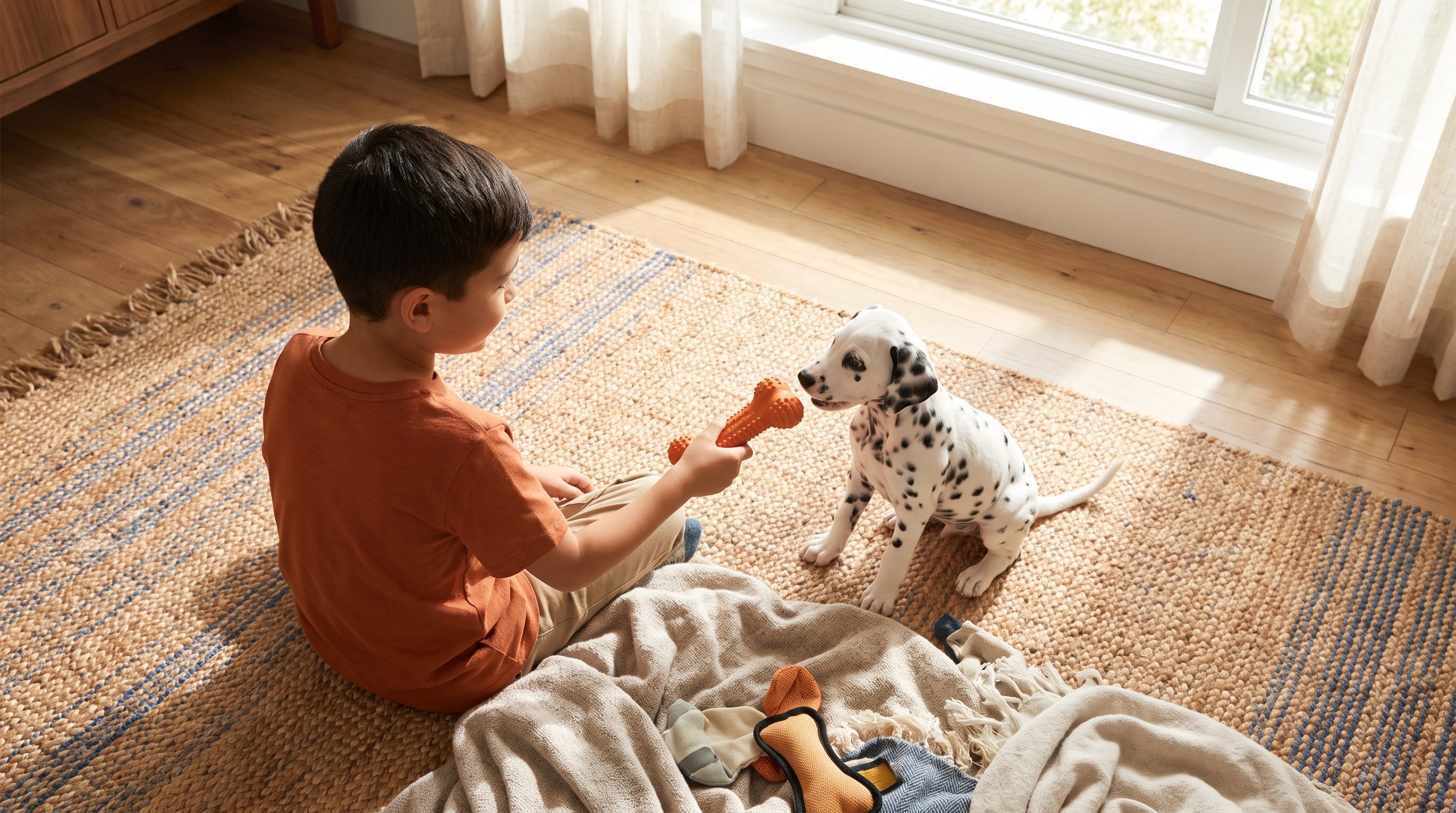
A short, written house rule - yelp, withdraw, offer toy - helps everyone respond the same way without having to remember the steps mid-moment.
Raising Dog's lessons are built around a puppy's current age and bite stage, so the response you're asked to practice matches what the puppy is actually doing that week rather than a generic script.
A Four-Stage Plan for Easing Out Puppy Biting
The order below matters more than the exact day count - some puppies move through these stages faster, some slower.
| Stage | What To Work On | What You're Aiming For |
|---|---|---|
| Stage 1 | Yelp and withdraw | Puppy notices bites end play |
| Stage 2 | Add toy redirection | Puppy chooses toy over skin |
| Stage 3 | Lower bite pressure | Mouth softens even during excitement |
| Stage 4 | Generalise to guests and kids | Soft mouth holds outside normal routine |
When Puppy Biting Usually Starts to Ease
Most owners want a date, and there isn't one to give honestly - puppies vary, and biting tied to teething tends to hang around longer than biting tied to play alone.
What tends to happen is gradual: fewer bites per play session, softer pressure when they do happen, and faster recovery after the yelp-and-withdraw response.
The point owners usually quit is a few weeks in, right when progress feels slow but is actually still building - staying consistent through that stretch is what gets the habit to fade.
Common Mistakes That Keep Puppy Biting Going
Rough Wrestling Games
Hands-on wrestling teaches a puppy that hands are for biting, so switch rough play to tug toys and fetch instead.
Inconsistent Reactions Across the House
If one person laughs off a bite and another scolds it, the puppy can't learn the rule - agree on one response and stick to it.
Punishing Instead of Redirecting
Shouting or physical correction can make a puppy more frantic, not less, so withdrawal and redirection work better than punishment.
Skipping Chew Outlets
A puppy without appropriate things to chew will find your hands and furniture instead, so keep chew items within reach all day.
Letting Overtiredness Build
Biting spikes sharply once a puppy is overtired, so ending play and offering rest often solves more than any correction would.
Teaching a Soft Mouth With Raising Dog's Lesson Plans
Generic bite-training advice tells every puppy to do the same thing on the same timeline, but a Labrador at ten weeks and a terrier at five months are working through completely different stages.
Raising Dog is a fully customized dog training book, built around your puppy's age and behavior stage rather than a one-size answer, with lessons that walk you through bite inhibition step by step alongside guidance for other behavior challenges.
The companion app tracks your puppy's progress and gives you insights as the biting stage shifts, so you always know which part of the plan to focus on next, with the whole guide on hand whenever you need it.
Raise A Happy Dog
Train Your Dog Right
Making Tonight's Play Session the Turning Point
Pick one response - yelp, withdraw, offer a toy - and use it the very next time teeth touch skin tonight, not next week.
Get the rest of the household on the same page, keep chew items nearby, and let Raising Dog fill in the stages as your puppy's biting changes over the coming weeks.
FAQ
It varies by puppy, breed and how consistent the household response is, so there's no fixed number to give honestly. What matters more than timing is sticking with the same response every time teeth land on skin.
Mouthing is normal puppy behaviour, but it's still worth shaping early since an adult dog with no bite inhibition is harder to manage than a puppy learning the rule now. Teaching a soft mouth now prevents bigger problems later, not because biting is dangerous in itself.
Some puppies do get more wound up by a yelp, in which case a silent stand-and-withdraw works better than a vocal one. Watch how your puppy responds and adjust the exact cue rather than abandoning the method.
Evening biting spikes are usually tied to overtiredness building across the day, not a step backward in training. Raising Dog's age-based lessons account for these daily energy patterns, so the plan adjusts rather than asking for the same response regardless of time of day.
Share this post