How To Train A Dog To Stop Jumping On People
By:Author:Raising Dog Editorial
Updated on:October 20, 2026
- The Myth of the One-Off Correction
- What's Actually Happening When a Dog Jumps Up
- What Changes How Fast Jumping Stops
- A Sample Week of Jumping Practice
- Making Jumping Practice Work With Actual Guests
- When Jumping Usually Starts to Fade
- Common Mistakes When Stopping Dog Jumping
- Working Through Jumping With Raising Dog's Lesson Plans
- Teaching Calm Greetings Starting Today
The fastest way to stop a dog jumping is to remove the reward for it - that means no eye contact, no touch, no talking until all four paws are on the ground.
Jumping sticks around because it works. A dog jumps, gets attention (even a scolding counts), and learns the move pays off, so the fix is to make the floor the only position that gets anything good.
This guide covers why the quick fixes people try usually backfire, what actually changes the behaviour, a sample week of practice, and where this habit tends to resurface even after it seems solved.
The Myth of the One-Off Correction
A lot of owners think one firm knee-to-the-chest or a loud 'no' will solve jumping for good. It rarely does, because a single correction doesn't teach the dog what to do instead - it only interrupts what it's already doing.
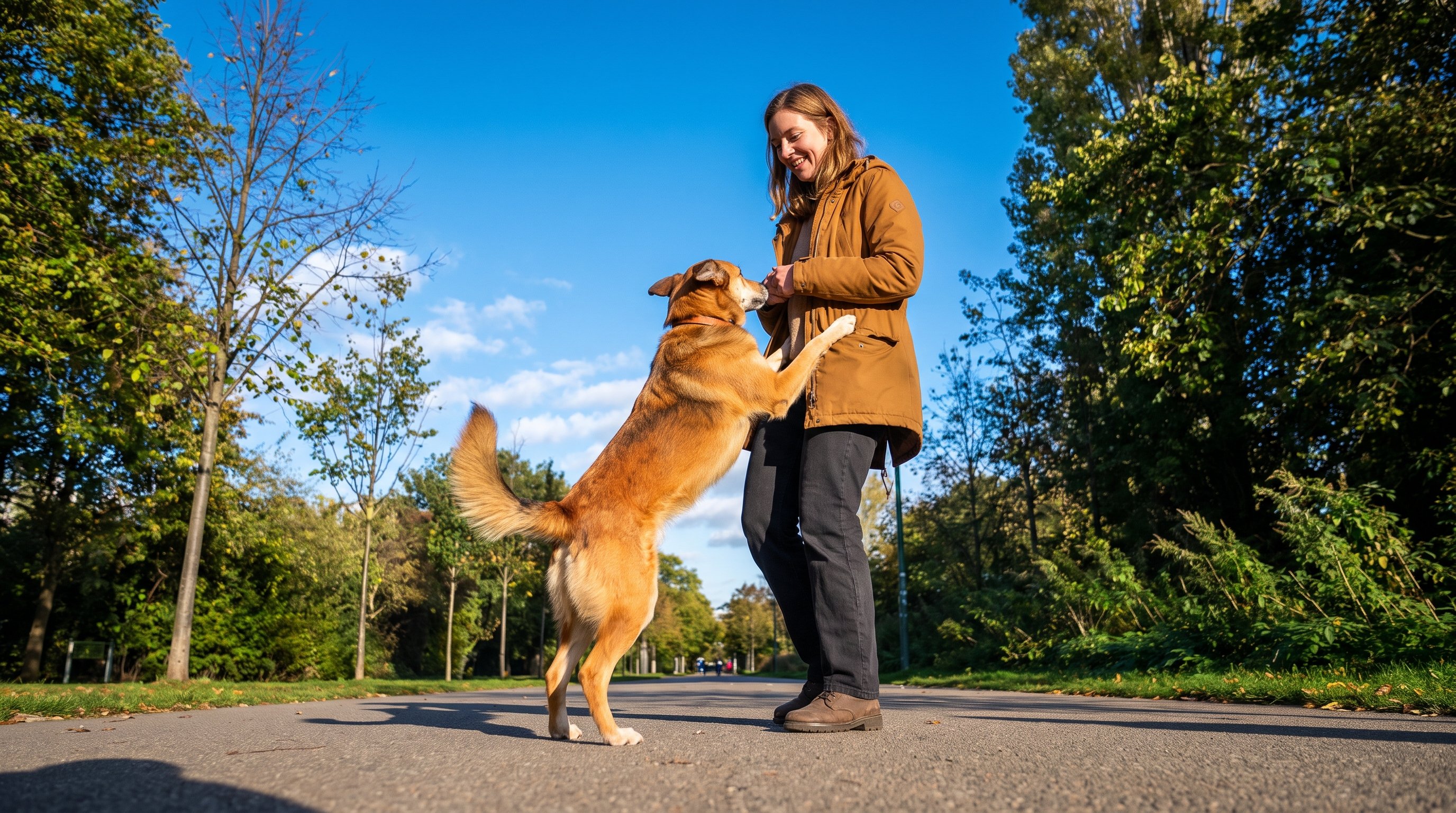
Jumping is a greeting behaviour. Dogs jump to get closer to a face, and until there's a new habit competing for that same moment - the door opening, a person walking in - the old one keeps winning.
The real fix is building a replacement behaviour, usually sitting or standing still, and reinforcing that instead of just punishing the jump.
What's Actually Happening When a Dog Jumps Up
Jumping isn't defiance. It's a dog doing the thing that's worked before, aimed at getting attention fast.
Jumping Is a Learned Shortcut
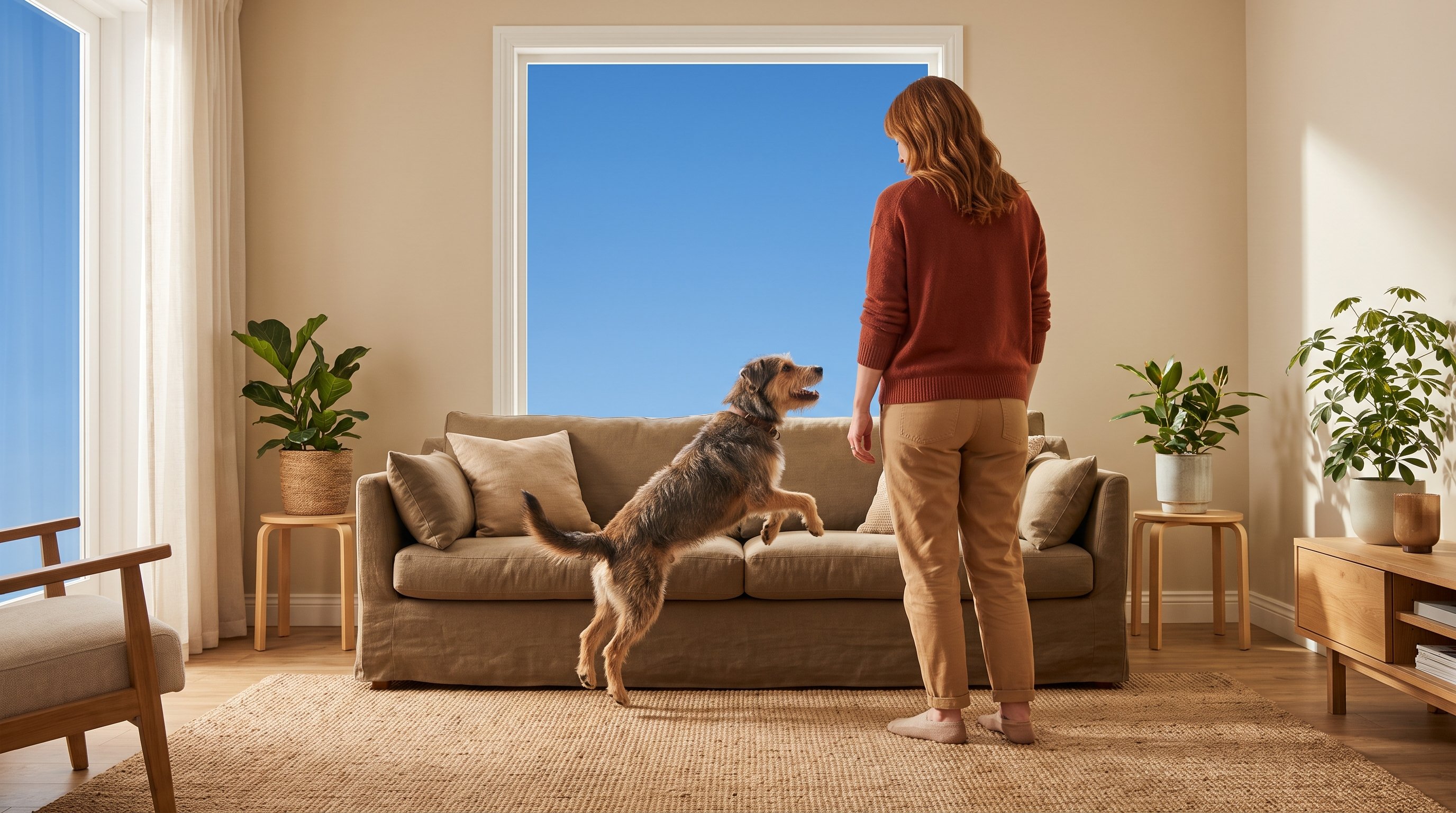
The first time a puppy jumps and gets picked up, laughed at, or even pushed off, it's learned that jumping gets a reaction. Dogs repeat whatever gets a reaction, so without a clear alternative, jumping becomes the default greeting.
Excitement Needs Somewhere to Go
A lot of jumping happens at high-arousal moments - someone coming home, a visitor at the door - when the dog has more energy than it knows what to do with. Teaching a sit or a four-paws-on-the-floor rule gives that energy a job instead of letting it spill out as jumping.
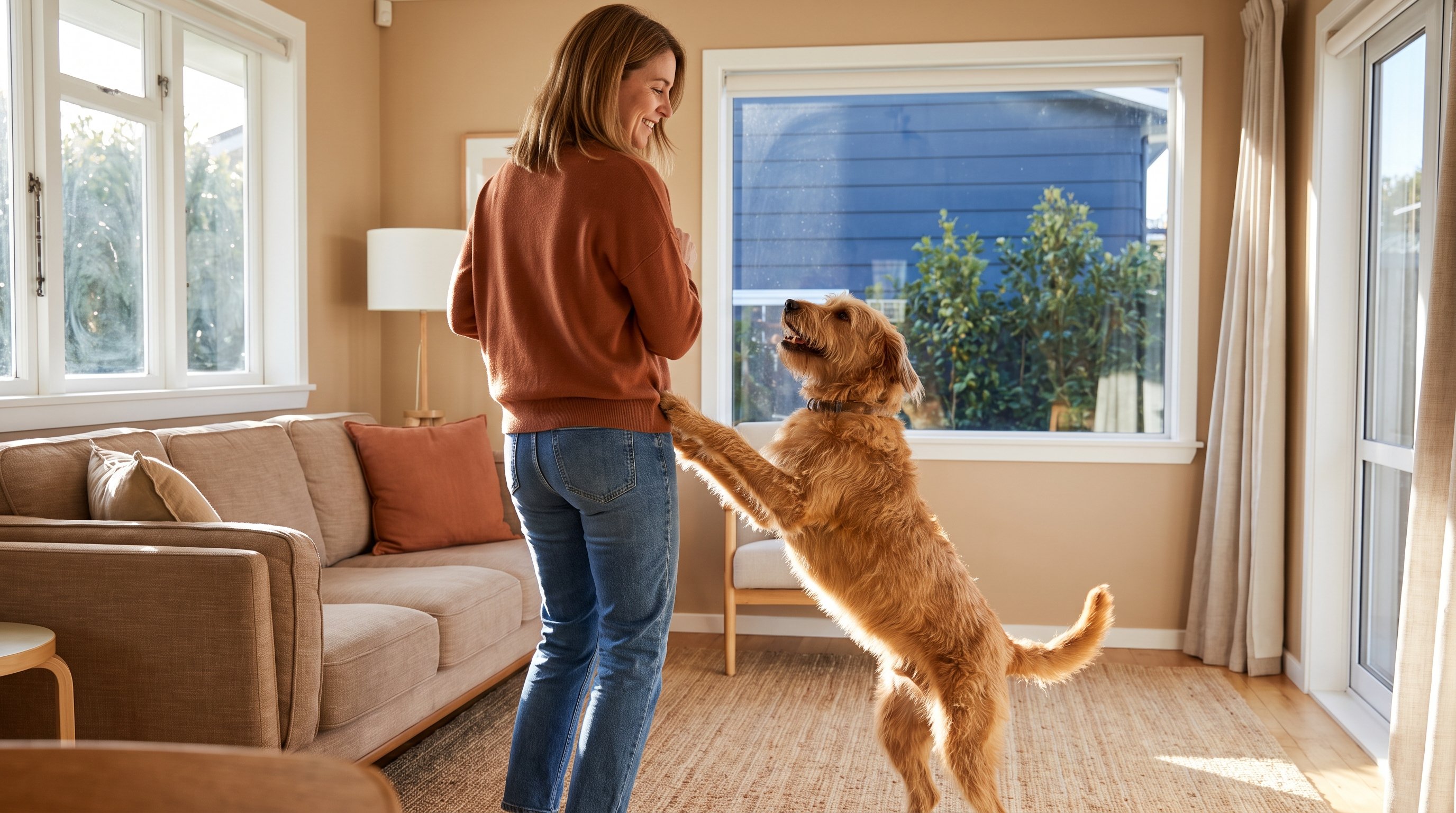
Once the dog realises calm gets the reward and jumping gets nothing, the behaviour starts to fade on its own.
What Changes How Fast Jumping Stops
Not every household sees the same speed of change. Three things tend to matter more than anything else.
Biggest Factors in Stopping Jumping
- Everyone's consistency - if one person allows jumping and another blocks it, the dog gets a mixed signal and the habit lingers longer.
- Timing of the reward - praise or attention needs to land the instant all four paws are down, not a few seconds later when the dog's already jumped again.
- Practising at the actual trigger - training in a quiet room doesn't transfer to the front door unless the door itself becomes part of the practice.
A Sample Week of Jumping Practice
This is a realistic weekly build, not a one-day fix. Short, repeated reps beat long occasional sessions.
| Timeframe | What To Work On |
|---|---|
| Days 1 to 2 | Reward sit at calm moments |
| Days 3 to 4 | Practise at low-key door openings |
| Days 5 to 6 | Add a helper walking in |
| Day 7 | Try it with real visitors |
Making Jumping Practice Work With Actual Guests
Training alone in the hallway is easy. The real test is a visitor who's excited to see the dog and forgets the plan the second the door opens.
A short heads-up to guests - ask them to ignore the dog until it's sitting - saves weeks of mixed signals, and keeping a leash near the door for the first few tries gives you a way to guide the dog back down without wrestling.
This is where a tailored plan helps, since a dog that jumps mainly at strangers needs a different sequence than one that only jumps on family, and Raising Dog breaks that distinction into separate steps rather than one generic script.
When Jumping Usually Starts to Fade
There's no fixed day this clicks, and any claim otherwise isn't being straight with you. What tends to happen is the jump gets smaller and less frequent before it disappears completely.
Expect a stretch where the dog still jumps with strangers or in high-excitement moments even after it's solid with the family. That's not a setback, it's just a less-practised version of the same skill.
People often give up right around the point the dog is starting to hesitate before jumping - that hesitation is actually the first sign it's working.
Common Mistakes When Stopping Dog Jumping
Pushing the Dog Off
Pushing with hands or knees still counts as touch, and touch is often exactly what the dog was jumping for. Turning away in silence removes the reward completely instead of accidentally feeding it.
Only Practising When Calm
A dog that's perfect in a quiet room can fall apart the second a visitor arrives, because the skill was never tested under excitement. Build up to real distractions gradually instead of stopping at the easy version.
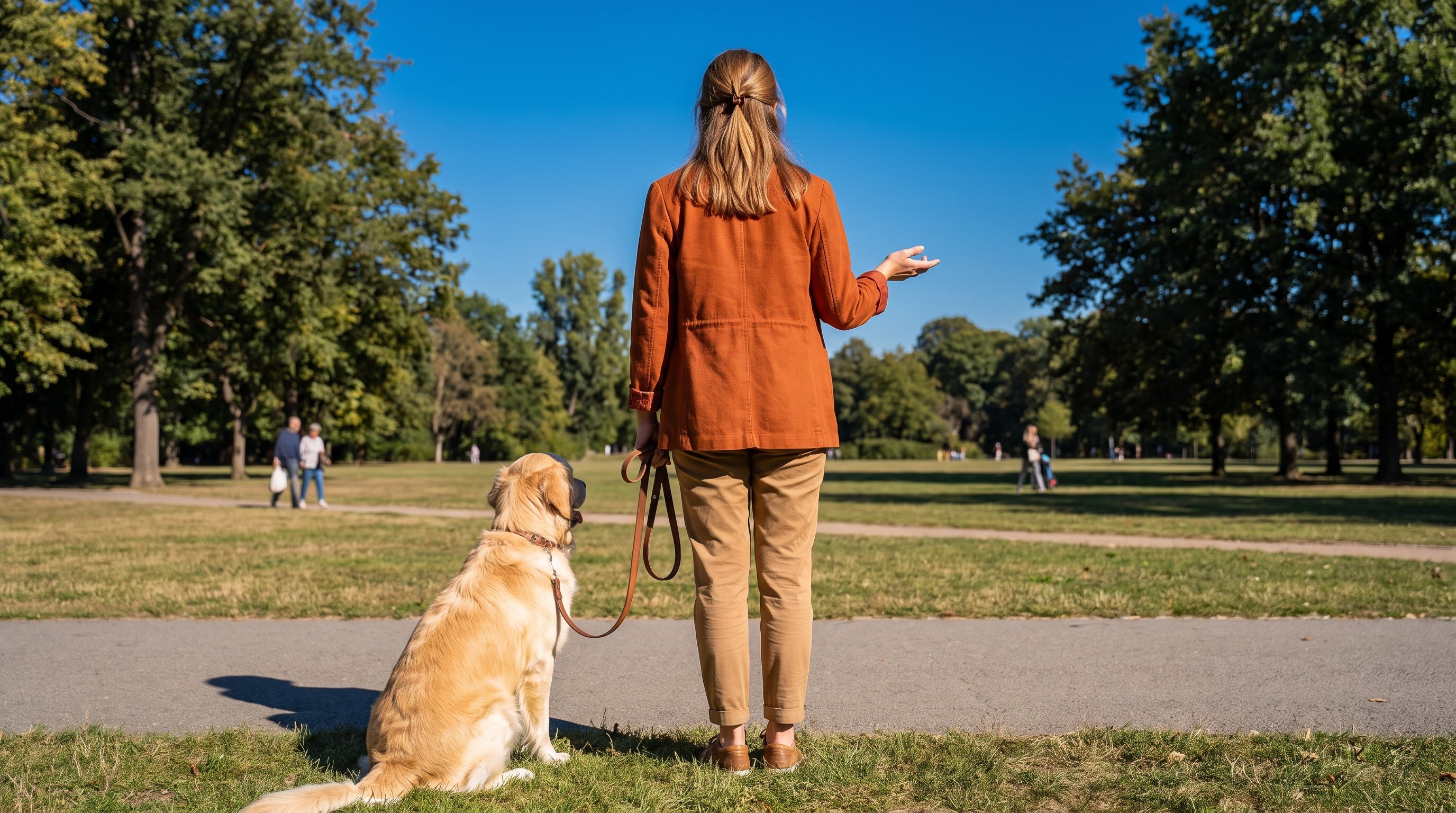
Letting It Slide Sometimes
Allowing jumping in pyjamas but blocking it in work clothes tells the dog the rule is about the person, not the behaviour. Keep the response the same every single time, no exceptions for mood or outfit.
Skipping the Replacement Behaviour
Blocking the jump without teaching a sit or stand just leaves a gap the dog will fill with something else, maybe barking or spinning. Always have an alternative ready to reward before the jump even starts.
Working Through Jumping With Raising Dog's Lesson Plans
Generic jumping advice assumes every dog, every doorway and every household guest reacts the same way, and that's rarely true.
Raising Dog builds its jumping lessons around your dog's age and current habits, so a six-month-old puppy that jumps out of pure excitement gets a different sequence than an older dog that's been rehearsing the habit for years. The companion app tracks how each session goes, so you can see where progress is sticking and where it needs another week of reps.
Raise A Happy Dog
Train Your Dog Right
Teaching Calm Greetings Starting Today
Pick one thing to do differently the next time the door opens: turn away, say nothing, and reward the moment all four paws land on the floor.
That single change, repeated consistently, does more than any one-off correction ever will, and Raising Dog can give you the next steps once that first rep feels natural.
FAQ
Some dogs calm down a little with age, but jumping that's been rewarded for months or years usually needs active retraining to actually stop. Waiting it out tends to just make the habit more established.
It feels that way at first, but brief, calm ignoring is far gentler than yelling or shoving, and it teaches the dog exactly what gets attention instead. The goal is a clear signal, not a cold shoulder.
That's common, and it usually means the dog has had more unplanned practice jumping on guests than on people it sees every day. Raising Dog's lesson plans separate out family greetings from visitor greetings so each gets its own practice sequence.
A sudden bounce-back usually means excitement levels spiked, perhaps a new visitor or a missed walk, and the dog reverted to the easier habit. It's not a failure of the training, just a sign the behaviour still needs practice under higher-energy conditions.
Share this post