Mental Stimulation for Dogs: A Daily Plan That Works
By:Author:Raising Dog Editorial
Updated on:October 20, 2026
- Does Mental Stimulation Actually Calm a Dog Down?
- How Brain Games Actually Tire a Dog Out
- How Much Mental Stimulation Does a Dog Need Daily
- Why Short Brain Games Beat Longer Walks Alone
- Fitting Mental Stimulation Into a Normal Day
- The Myth of the Instant Calm-Down Toy
- What Actually Changes How Tired a Dog's Brain Gets
- Common Mistakes With Mental Stimulation for Dogs
- Building Mental Stimulation Into Raising Dog's Daily Plan
- Giving Today's Routine One Small Brain Job
Mental stimulation for dogs means giving the brain a job: sniffing out food, solving a puzzle, learning a new cue. A tired brain settles a dog the same way a tired body does, often with less mess and no extra space needed.
The mechanism is simple. Problem-solving and scent work ask a dog to concentrate, and concentration burns energy the same way a long walk does, just through a different channel.
This article covers whether brain games actually change behaviour, how much is enough, how to fit it into a normal week, and where it falls short of fixing everything on its own.
Does Mental Stimulation Actually Calm a Dog Down?
Yes, within reason. A dog working through a snuffle mat or a new trick is using focus and decision-making, and that kind of effort tires a brain out the way a jog tires legs out.
The arithmetic is plain: ten minutes of sniffing and searching asks for sustained attention, and sustained attention is tiring in a way that pacing around a living room is not.
It will not replace physical exercise outright, and it will not undo a dog's entire day of boredom in one short session, but it adds a second, separate way to use up energy that walking alone does not cover.
How Brain Games Actually Tire a Dog Out
Mental stimulation works through two separate channels, and knowing both helps you pick activities that actually land.
Problem-Solving Uses Working Memory
Puzzle feeders and hide-and-seek games ask a dog to try something, fail, and adjust, which pulls on working memory the same way a logic puzzle does for a person. That trial-and-error loop is what makes the activity tiring rather than just distracting.
Scent Work Uses a Different Kind of Focus
A dog's nose is built for sustained tracking, so scatter-feeding or scent trails ask for a slower, steadier kind of attention than a fast game of fetch. That steady focus is often what settles a wound-up dog faster than more running around would.
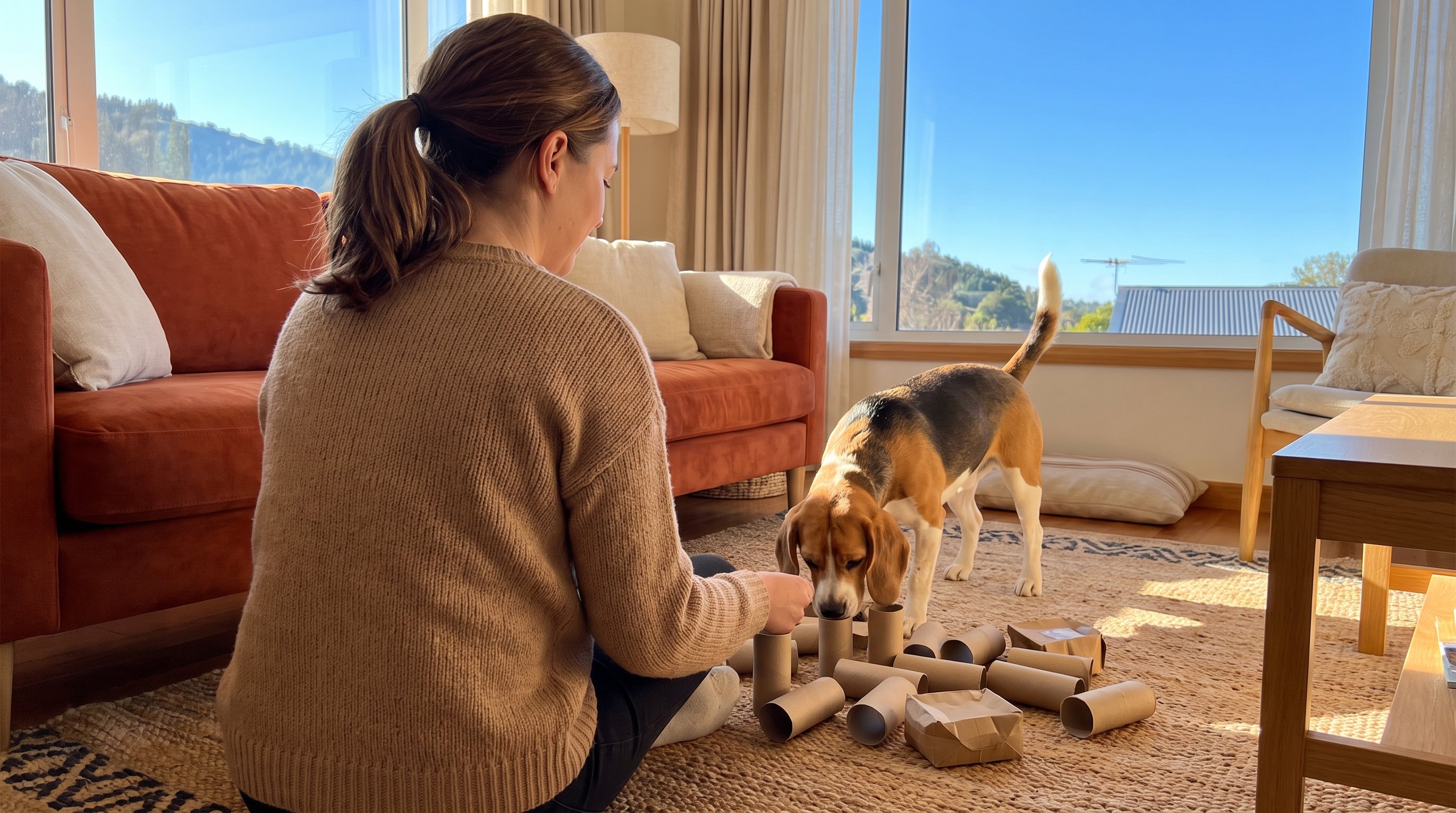
Put together, problem-solving and scent work cover most of what people mean by mental stimulation, and a week that includes both tends to be more balanced than one that leans on just one type.
How Much Mental Stimulation Does a Dog Need Daily
There's no single number that fits every dog, but a short daily dose beats one long weekly session by a wide margin, the same way daily brushing beats a once-a-week scrub.
Starting Small and Building Up
Five to ten minutes a day of a puzzle feeder or a sniff-based game is enough to notice a difference in most dogs, and it can grow from there as the dog gets quicker at solving things.
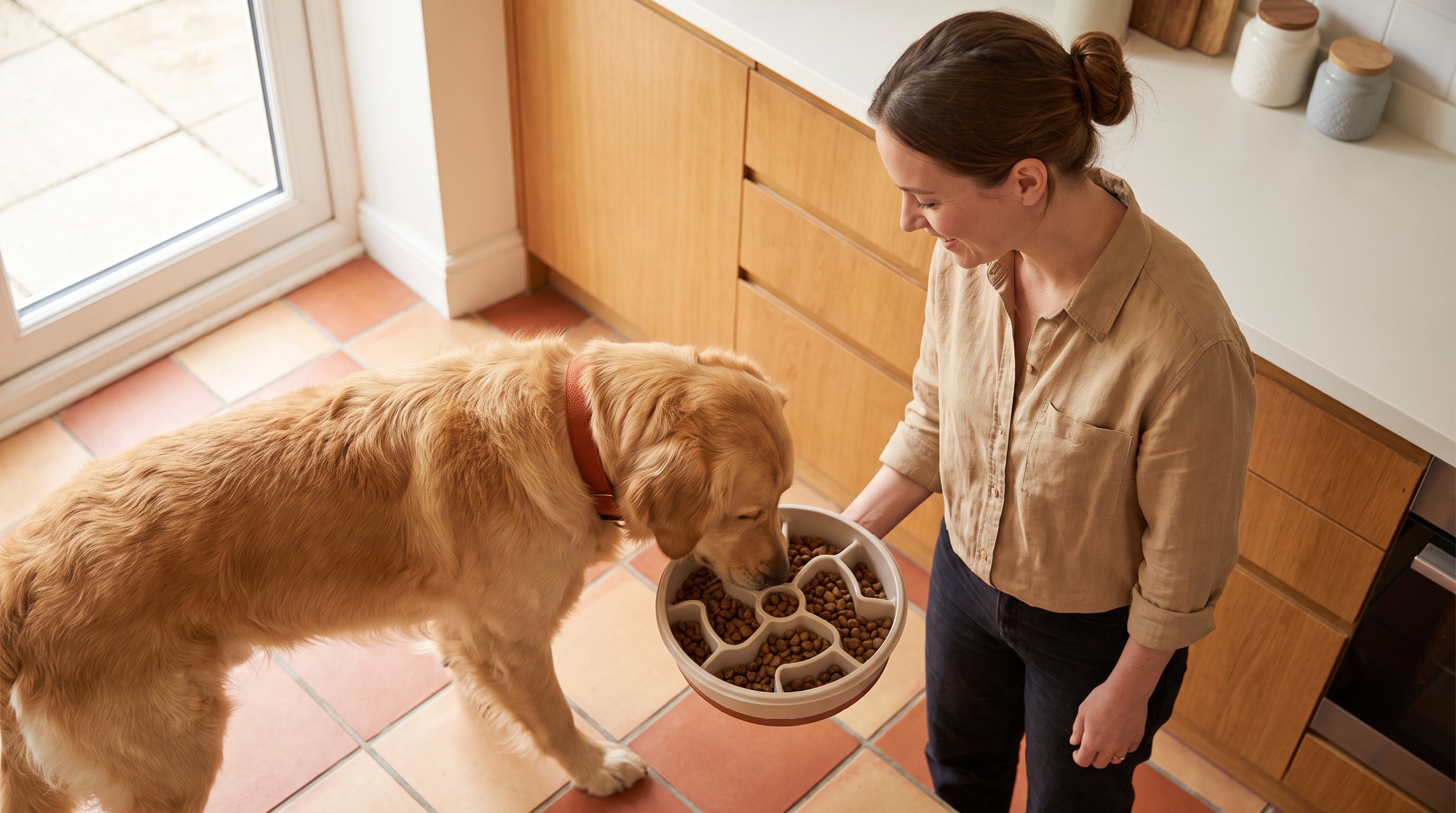
| Activity | Length | When |
|---|---|---|
| Snuffle mat or scatter feed | 5 to 10 minutes | Before a busy day |
| Puzzle feeder with meal | 10 to 15 minutes | Mealtime, once daily |
| New trick practice | 5 minutes | Short burst, any time |
| Scent trail in garden | 10 minutes | Before or after a walk |
| Frozen stuffed toy | 15 to 20 minutes | Quiet afternoon stretch |
None of this needs to happen all at once. Spreading two or three short sessions across the day usually works better than cramming it into one block.
Why Short Brain Games Beat Longer Walks Alone
The harder alternative here is simply walking more, adding another thirty minutes onto an already long loop to try to wear a dog out through distance alone.
That works for a while, but distance has diminishing returns, and a fitter dog just gets more efficient at walking rather than more tired by it.
A short puzzle session asks for something walking doesn't: concentration. It's also far easier to keep up every single day, which matters more than any single big outing because consistency is what actually changes a dog's baseline energy level.
Fitting Mental Stimulation Into a Normal Day
The easiest way in is to attach a brain game to something that already happens, so it doesn't become one more thing on the to-do list.
Feeding a meal from a puzzle feeder instead of a bowl costs nothing extra in time, and a five-minute trick session before dinner fits into the gap most people already have while waiting for food to cook.
Raising Dog's activity ideas are built around this kind of stacking, with age-appropriate games sized to fit small windows in a normal day rather than requiring a dedicated training slot.
The Myth of the Instant Calm-Down Toy
No single toy or puzzle switches a dog from wired to settled in one go, and any claim that it does is worth being sceptical of.
A dog that's had a rough day, missed a walk, or is just naturally high-energy isn't going to be fixed by ten minutes with a snuffle mat, because mental stimulation is one piece of a bigger picture that includes exercise, sleep and routine.
The honest answer is that brain games work best as a steady habit, not a rescue tool pulled out in a crisis. Over time, regular mental work tends to lower a dog's baseline restlessness, but it's additive, not a reset button.
What Actually Changes How Tired a Dog's Brain Gets
Some factors matter more than others for getting real value out of mental stimulation.
What Makes the Biggest Difference
- Novelty - a dog that's solved the same puzzle fifty times stops having to think about it, so rotating two or three activities keeps the brain actually working.
- Difficulty matched to the dog - a puzzle that's too easy is just a snack dispenser, and one that's too hard leads to giving up, so the sweet spot is slightly challenging.
- Consistency - a brain game done daily in short bursts builds a habit that a single long session on the weekend never will.
Common Mistakes With Mental Stimulation for Dogs
Using the Same Puzzle Every Day
A dog that's mastered a puzzle feeder isn't being challenged any more, it's just eating from an odd-shaped bowl. Swap between two or three different games so the problem-solving part stays active.
Treating It As a Replacement for Exercise
Mental stimulation adds to a dog's day, it doesn't substitute for a walk entirely. Both channels of energy need an outlet, and skipping one to lean on the other usually leaves something unmet.
Making Sessions Too Long Too Soon
A dog new to puzzle feeders can get frustrated fast if the challenge is too big on day one. Start short and easy, then build difficulty gradually as the dog gets confident.
Only Doing It When the Dog Is Already Wound Up
Saving brain games for moments of chaos means they're competing with a dog that's already overstimulated and struggling to focus. A calmer baseline moment works better for actually teaching the dog to concentrate.
Building Mental Stimulation Into Raising Dog's Daily Plan
Generic lists of puzzle toys don't account for a dog's age, breed tendencies or how much time a household actually has, which is where most brain-game advice falls flat.
Raising Dog tackles this with over 100 training and play ideas tailored to a dog's age and needs, so the suggestions fit a young, high-energy puppy differently than they'd fit an older dog that tires out faster.
The tricks and games built for bonding double as mental workouts, and the assistant app tracks what's been tried so sessions stay varied instead of repeating the same puzzle out of habit.
Raise A Happy Dog
Train Your Dog Right
Giving Today's Routine One Small Brain Job
Pick one meal today and serve it from a puzzle feeder or scattered across the grass instead of a bowl, and notice how much longer it takes and how much calmer the dog is afterwards.
That single swap is the whole starting point, and Raising Dog's game ideas are there for the next step.
FAQ
There's no fixed timeline, and it depends on the dog's age, energy level and how consistent the sessions are. Some dogs settle noticeably within a couple of weeks of daily short sessions, others take longer.
A walk gives a dog plenty to sniff and look at, but it's not the same as a focused problem-solving task. Pairing a short brain game with regular walks covers both the physical and mental side.
That usually means the puzzle is too easy or it's been used too many times in a row. Rotating two or three different types of games, including scent-based ones, tends to hold attention longer.
Raising Dog's lesson plans are built around a dog's specific age and needs, so the starting activities are already matched rather than guessed at. That takes the trial and error out of picking the first few games.
Share this post