Puppy Teething: A Calm Plan For Chewing And Sore Gums
By:Author:Raising Dog Editorial
Updated on:October 18, 2026
- Does Anything Actually Ease Puppy Teething?
- Frozen Chews Versus Textured Toys: Which to Reach For
- Why Redirecting Chewing Beats Stopping It
- Adjusting Teething Support for Different Puppies
- Fitting Teething Relief Into a Normal Week
- The Myth of the Overnight Teething Fix
- Supporting Puppy Teething With Raising Dog's Guidance
- Getting Through the Teething Weeks With Less Stress
Puppy teething is a stage, not a problem to solve. It usually runs from around the time baby teeth start loosening through to when adult teeth settle in, and the chewing, drooling and sore-gum crankiness are the puppy's way of coping with it.
The mechanism is simple: new teeth pushing through sore gums create pressure, and chewing on something firm or cold relieves that pressure the same way pressing an aching tooth with your tongue feels oddly satisfying.
This article covers what's actually happening during teething, whether chew toys and frozen options make a real difference, how to fit relief into daily life, and where structured guidance fits into the picture.
Does Anything Actually Ease Puppy Teething?
Yes, within limits - you can't speed up tooth development, but you can reduce the discomfort that drives destructive chewing.
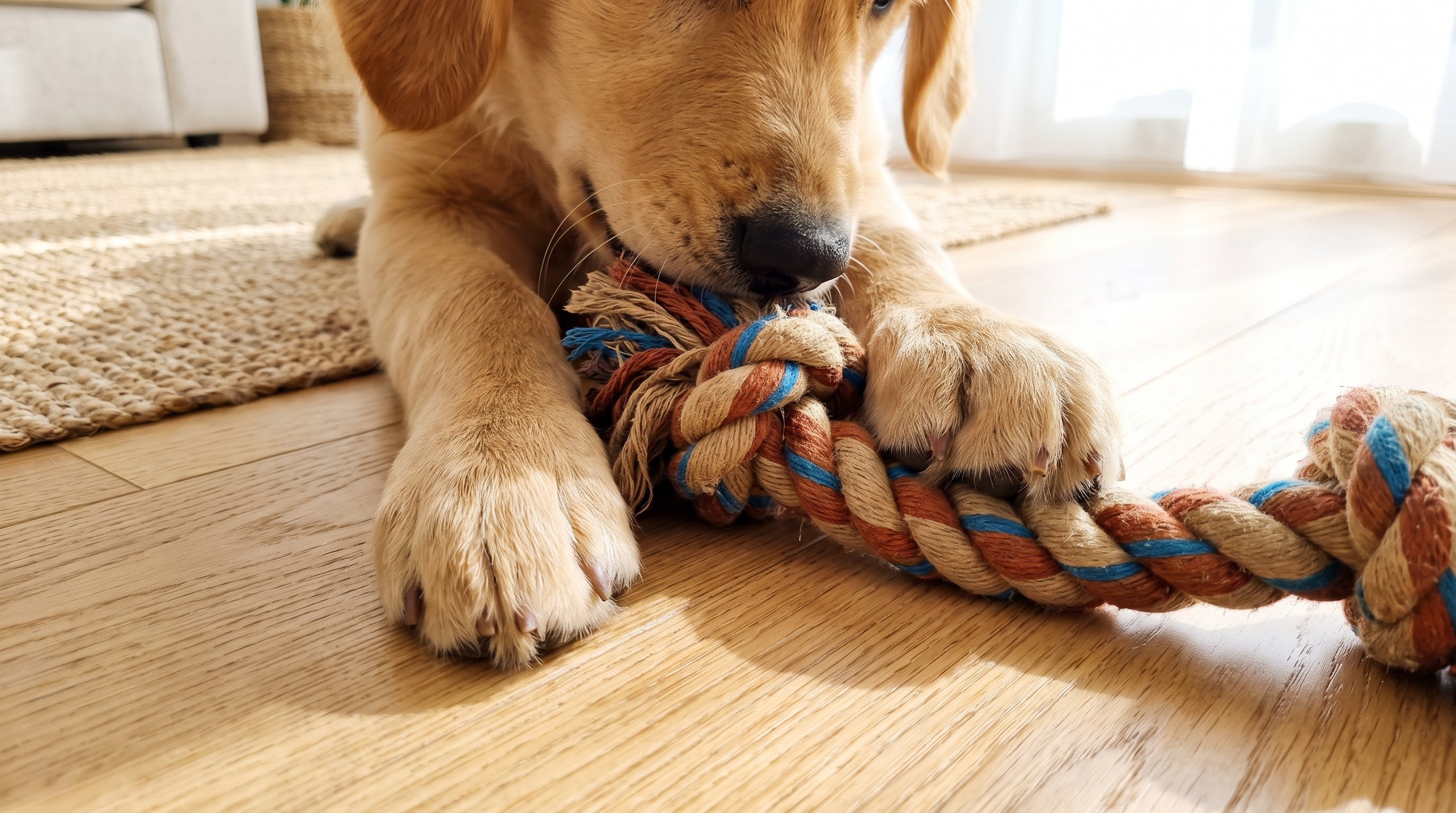
Cold items numb sore gums the way an ice pack numbs a bruise, and firm rubber toys give the puppy something satisfying to bite down on instead of a chair leg or your hand.
The Arithmetic of a Teething Day
A puppy might chew for short bursts many times across a day rather than one long session, so offering a rotation of two or three approved chew items covers more of those moments than a single toy left in the corner.
Swap the items every few hours and the novelty itself does some of the work, since a puppy returning to the same toy for the fifth time that day gets less relief from it than a fresh one.
Frozen Chews Versus Textured Toys: Which to Reach For
Both have a place, and the honest answer is that most households end up using both depending on the moment.
A frozen washcloth or chew works best when gums look visibly sore or swollen, while a textured rubber toy suits general chewing energy that isn't tied to a flare-up.

| Option | Best For | Effort | Mess Level |
|---|---|---|---|
| Frozen chew | Visibly sore gums | Needs freezer time | Some drip as it melts |
| Textured rubber toy | General chewing energy | Ready any time | Minimal |
| Frozen washcloth | Quick cold relief | Low, reusable | Damp patches |
| Soft fabric toy | Comfort chewing | Low | Can get soggy |
| Firm nylon chew | Stronger chewers | Low, durable | Minimal |
Neither option needs to be expensive or complicated, which is part of why rotating a handful of them tends to work better than searching for one perfect solution.
Why Redirecting Chewing Beats Stopping It
Trying to stop a teething puppy from chewing entirely is the harder road, mostly because it fights a physical need rather than managing it.
Redirecting - swapping the shoe for an approved chew the moment it starts - works with the urge instead of against it, which is why it tends to stick when scolding alone doesn't.
A puppy that's told no with nothing offered in return will usually just find another object a few minutes later, since the underlying pressure in the gums hasn't gone anywhere.
Consistent redirection, repeated every single time, is unglamorous and it wins anyway - not because it's exciting, but because it's the only approach that addresses what's actually causing the chewing.
Adjusting Teething Support for Different Puppies
The Small-Breed Puppy
Smaller jaws need smaller, softer chew options, since a toy sized for a larger breed can be awkward or even uncomfortable to grip.
The Powerful Chewer
Some puppies go through chew items fast, so firmer nylon or rubber options built to hold up longer make more sense than soft fabric toys that tear apart in minutes.

The Busy Household
If nobody's home to supervise constantly, keeping a few chew-safe items in every room the puppy has access to cuts down on the chances it reaches for something it shouldn't.
The Multi-Dog Home
A teething puppy around an older dog may need its own designated chews kept separate, since competing over one toy can turn a calm chewing moment into a tense one.
Fitting Teething Relief Into a Normal Week
Teething doesn't pause for a busy schedule, so the goal isn't a perfect routine - it's a few reliable habits repeated often enough to matter.
Keeping a chew toy near the door, the sofa and the crate means there's always something close by the moment chewing starts, rather than a scramble to find one.
This is also where a structured plan helps more than scattered advice, and it's a big part of why Raising Dog builds guidance around a puppy's actual age and stage rather than generic tips that assume every teething puppy behaves the same way.
Having that kind of tailored structure written down means less guessing about what's normal and what needs more attention on any given day.
The Myth of the Overnight Teething Fix
There's no product or trick that ends teething in a day, and anyone promising that isn't being straight with you.
Teeth come in on their own timeline, and no amount of chewing management speeds up the biology underneath it.
What actually helps is reducing discomfort in the moment and protecting your belongings while the process runs its course, not chasing a shortcut that doesn't exist.
The real answer is patience paired with consistent redirection, which sounds unremarkable but is genuinely what gets most households through this stage.
Supporting Puppy Teething With Raising Dog's Guidance
Generic chewing advice fails on fit, not on quality - what works for a large powerful chewer can be wrong for a small breed with a delicate jaw, and most articles can't account for that.
Raising Dog tackles this by tailoring its lessons to your dog's age and unique needs, which matters during teething since the right chew approach shifts as teeth come in and fall out over several weeks.
The book also includes tips to overcome behavior issues like destructive chewing, so redirecting a puppy away from furniture becomes a clear plan rather than guesswork, and the companion app tracks progress so you can see what's actually changing week to week.
Raise A Happy Dog
Train Your Dog Right
Getting Through the Teething Weeks With Less Stress
Puppy teething passes, even on the days it doesn't feel like it will, and the most useful thing you can do is keep approved chews within reach and redirect calmly every time.
If you want that redirection built into a wider plan rather than figured out on the fly, structured guidance lays out what to expect at each stage so the chewing phase feels manageable instead of chaotic.
FAQ
It varies by puppy, running from the early loosening of baby teeth through to adult teeth settling in fully. There's no fixed date to circle on the calendar, so watching behaviour and gums matters more than counting weeks.
They won't eliminate chewing altogether since it's a physical need, not a bad habit, but offering the right chew at the right moment redirects that need away from furniture and shoes. Consistency in offering them matters more than the toy itself.
Try rotating between a few different textures and temperatures, since a puppy that ignores a room-temperature toy might go straight for a frozen one when gums feel sore. Raising Dog's lessons help you figure out what suits your specific puppy's chewing style instead of guessing toy by toy.
Chewing intensity typically settles once adult teeth are fully in, though the chewing habit itself can linger a while longer as a learned behaviour. Keep offering appropriate outlets even after the sore-gum stage passes, since the habit doesn't always disappear the moment the discomfort does.
Share this post